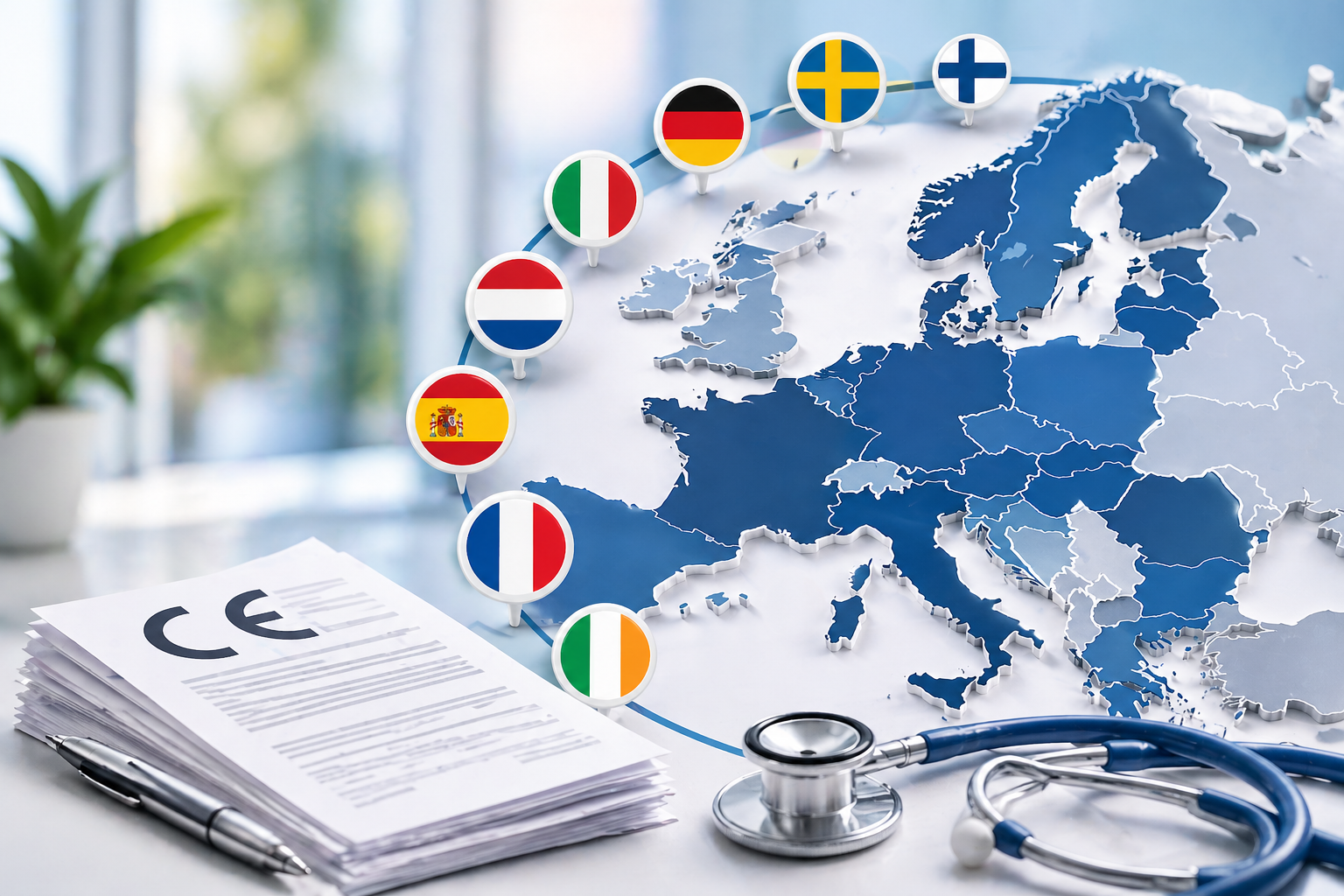
You need to provide medical device labeling, Instructions for Use (IFUs), and safety information in the official language(s) of each EU country where your device is sold.
- Each EU member state sets its own language requirements
- Selling in one country may require only 1 language
- Selling across the EU may require 20+ languages
- Requirements apply to labels, packaging, and user documentation
Example:
If you sell in Germany, France, and Spain, you will need German, French, and Spanish translations.
The Rule Behind CE Marking Language Requirements
Under the EU Medical Device Regulation (MDR), all user-facing materials must be provided in the official language(s) of each EU country where the device is marketed.
This applies to:
- Instructions for Use (IFUs)
- Labels and packaging
- Safety and warning information
- Patient-facing materials
👉 Each EU member state sets its own language requirements.
So… How Many Languages Is That?
If you plan to sell across the entire EU, you may need to support up to 24 official EU languages.
However, most companies don’t launch everywhere at once.
Example Scenarios
Single-country launch (Germany)
→ German required
DACH region (Germany, Austria, Switzerland)
→ German (with regional nuances)
Western Europe (France, Spain, Italy, Germany, Netherlands)
→ French, Spanish, Italian, German, Dutch
Full EU distribution
→ Potentially 20+ languages depending on market coverage
The Mistake That Delays EU Market Entry
Many teams assume “We’ll translate into a few major languages and expand later.”
This often leads to:
- Regulatory delays
- Rejected submissions
- Labeling non-compliance
- Last-minute translation rushes
Why?
Because language requirements are tied to market authorization, not convenience.
It’s Not Just Translation—It’s Compliance
CE marking language requirements go beyond basic translation. They require:
- Regulatory-accurate terminology
- Consistency across labeling, IFUs, and submissions
- Alignment with country-specific expectations
- Traceable quality control processes
For example:
- A mistranslated safety instruction can create compliance risk
- Inconsistent terminology can delay approval
- Poor localization can impact usability and patient safety
How to Determine Your Exact Language Requirements
To determine how many languages you need, define:
- Target EU markets – Where will the device be sold?
- User type – Healthcare professionals, patients, or both?
- Device classification – Higher-risk devices require more robust documentation
- Documentation scope – What must be translated for compliance?
✅ CE Marking Language Requirements by Country (EU + EEA)
If you plan to sell across all EU and EEA markets, you may need to support 20+ languages to meet CE marking requirements.
| Country |
Required Language(s) |
Notes |
| Austria |
German |
Mandatory for all user-facing materials |
| Belgium |
Dutch, French, German |
Varies by region; often multiple languages required |
| Bulgaria |
Bulgarian |
Required for IFUs and labeling |
| Croatia |
Croatian |
Mandatory |
| Cyprus |
Greek |
Sometimes English accepted for professionals |
| Czech Republic |
Czech |
Mandatory |
| Denmark |
Danish |
Required |
| Estonia |
Estonian |
Mandatory |
| Finland |
Finnish, Swedish |
Both may be required |
| France |
French |
Strict enforcement |
| Germany |
German |
Mandatory |
| Greece |
Greek |
Mandatory |
| Hungary |
Hungarian |
Mandatory |
| Ireland |
English |
Irish rarely required in practice |
| Italy |
Italian |
Mandatory |
| Latvia |
Latvian |
Mandatory |
| Lithuania |
Lithuanian |
Mandatory |
| Luxembourg |
French, German |
Often accepts multiple languages |
| Malta |
English, Maltese |
English widely accepted |
| Netherlands |
Dutch |
Sometimes English accepted for professionals |
| Poland |
Polish |
Mandatory |
| Portugal |
Portuguese |
Mandatory |
| Romania |
Romanian |
Mandatory |
| Slovakia |
Slovak |
Mandatory |
| Slovenia |
Slovenian |
Mandatory |
| Spain |
Spanish |
Regional languages may apply |
| Sweden |
Swedish |
Mandatory |
| Norway (EEA) |
Norwegian |
Required for market access |
| Iceland (EEA) |
Icelandic |
Mandatory |
| Liechtenstein (EEA) |
German |
Follows Swiss/German standards |
In practice, most medical device companies need between 5 and 20+ languages depending on their EU market expansion strategy.
Why Language Strategy Should Be Planned Early
The most efficient regulatory teams treat language as part of their market entry strategy—not an afterthought.
Planning early helps you:
- Avoid rework across labeling and IFUs
- Streamline regulatory submissions
- Maintain consistency across global markets
- Reduce time to CE marking approval
Work with a Translation Partner That Understands CE Marking
Most translation providers focus on word counts.
But for CE marking, what matters is:
- Regulatory expertise
- Medical and technical accuracy
- Consistency across documentation sets
- Compliance with EU MDR expectations
At Rapport International, we support medical device and regulated industry teams with translation strategies designed for accuracy, compliance, and faster EU market entry.
Final Answer
So, how many languages do you need for CE marking?
As many as required by the EU countries where your device will be sold.
That could mean:
- 1 language
- 5 languages
- Or 20+ languages
The key is aligning your language strategy with your market expansion plan from the start.
Rapport International provides medical device translation and localization services for EU market entry, helping regulatory, labeling, and clinical teams meet CE marking language requirements with confidence.
Our services support:
- Translation of IFUs, labeling, and packaging
- EU MDR-compliant terminology management
- Consistent localization across multi-country submissions
- Faster, more efficient regulatory approval processes
Unlike general translation providers, Rapport International focuses on regulated industries where accuracy, compliance, and risk mitigation are critical.